



A women’s accessories brand in India approached PPC Digital to improve its website sales, acquire new customers, and build a stronger online presence. As a new business starting from scratch, the brand faced challenges with no sales, low average order value (AOV), website improvement needs, and limited social media visibility.
From June to September 2026, PPC Digital worked on a performance marketing strategy combining Google Ads, Meta Ads, social media management, influencer collaborations, and user-generated content (UGC).
The goal was to increase website sales, grow revenue, improve advertising performance, and build brand awareness.
Industry: Women’s Accessories
Market: India
Campaign Duration: June–September 2026
Services: D2C Performance Marketing, Google Ads, Meta Ads, Social Media Marketing, Influencer Marketing, and UGC
The Challenges
1. Building the Brand from Scratch
The business was new and needed to establish its online presence while attracting its first customers. It required a marketing strategy that could support customer acquisition and business growth.
2. Low Website Sales
Generating consistent website sales was a major challenge. The brand needed advertising campaigns that could reach relevant audiences and encourage more customers to purchase.
3. Low Average Order Value
The brand had a low average order value, making it important to focus on efficient campaign spending and improve the overall performance of its advertising efforts.
4. Website Improvement Needs
The website needed improvement to better support the brand’s sales goals. A website that communicates product value clearly and provides a smooth shopping experience is important for an e-commerce business.
5. Limited Social Media Presence
The brand had almost no established social media presence. It needed to build visibility, create engaging content, increase followers, and develop trust among potential customers.
Campaign Objectives
PPC Digital focused on the following objectives:
-
- Increase monthly website sales and overall revenue.
-
- Acquire more new customers.
-
- Improve the performance of Google Ads and Meta Ads.
-
- Optimize advertising budgets and campaigns.
-
- Build the brand’s social media presence from scratch.
-
- Increase social media followers and brand awareness.
-
- Support long-term growth for the D2C business.
Our Strategy
To address these challenges, PPC Digital implemented a multi-channel marketing strategy combining paid advertising with social media and creator-led content.
1. Google Ads Campaigns
Google Ads was used to reach potential customers actively searching for relevant products and to promote the brand’s product catalogue.
The campaign mix included:
-
- Shopping Ads: To showcase products to shoppers searching for relevant items.
-
- Search Ads: To reach users searching for relevant products and purchase-related terms.
-
- Performance Max (PMax): To support product promotion and conversions across eligible Google advertising placements.
Campaign performance was monitored, with attention given to search terms, product feed optimization, budgets, and underperforming campaigns.
2. Meta Ads Campaigns
Meta Ads helped the brand promote its products on Facebook and Instagram while reaching potential customers through product-focused advertising.
The campaign strategy included:
-
- Catalog Ads: To showcase products from the brand’s catalogue.
-
- Sales Campaigns: To focus advertising efforts on website purchases.
-
- Video and Static Creatives: To test different creative formats and understand which approaches performed better.
Creative testing, budget adjustments, and ongoing optimization were used to improve campaign performance over time.
3. Social Media Presence from Scratch
Alongside paid advertising, PPC Digital worked on building the brand’s social media presence from the ground up.
The focus was on developing visibility for the brand, presenting products through social content, and creating opportunities to connect with potential customers.
4. Influencer Marketing and Barter Collaborations
Influencer marketing was introduced to help the brand reach relevant audiences and present its products through creator content.
The approach included both paid and unpaid influencer collaborations, along with barter collaborations. These activities supported product visibility and helped the brand build its presence on social media.
5. User-Generated Content (UGC)
UGC was included in the marketing approach to provide creator-led product content that could support brand awareness and advertising creatives.
This helped add variety to the content used to present the products and communicate their value to potential customers.
6. Ongoing Campaign Optimization
PPC Digital continued monitoring campaign performance throughout the four-month period.
Key activities included:
-
- Reviewing and optimizing keywords and search terms.
-
- Improving product feed performance.
-
- Testing video and static ad creatives.
-
- Adjusting campaign budgets.
-
- Identifying and optimizing low-performing campaigns.
-
- Monitoring sales, advertising spend, and platform-reported ROAS.
Campaign Results
Project Overview
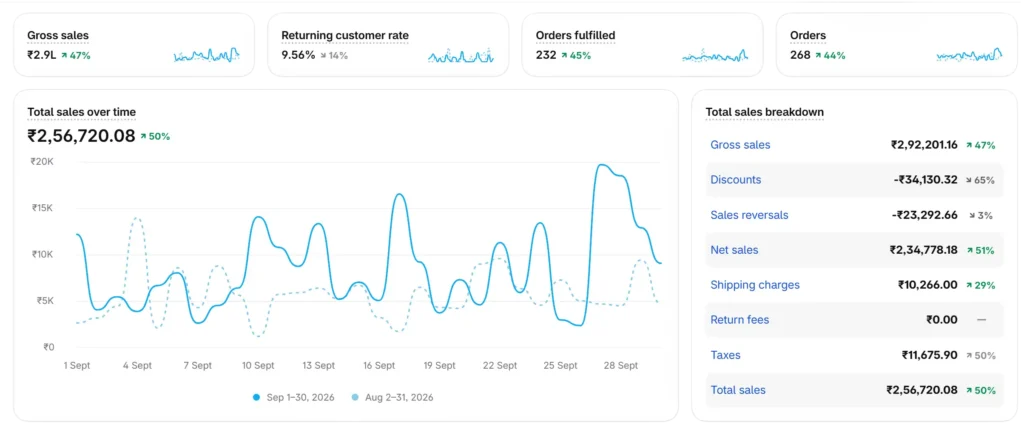
Between June and September 2026, the brand recorded substantial growth in monthly sales and new customer numbers.
| Metric | June 2026 | September 2026 |
| Total Sales | ₹43,038 | ₹2,56,720 |
| Gross Sales | ₹53,010.66 | ₹2,92,201.16 |
| New Customers | 51 | 241 |
| Meta Ads ROAS | 4.6x | 4.7x |
| Google Ads ROAS | 0.0x | 1.8x |
| Overall Reported ROAS | 4.4x | 5.1x |
Note: ROAS figures are the reported campaign figures shared for this case study. Platform-level ROAS and overall reported ROAS may use different attribution or reporting methods.
1. Monthly Sales Increased to ₹2.56 Lakh
The brand’s monthly total sales increased from ₹43,038 in June to ₹2,56,720 in September.
This represents an increase of approximately 496.6% over the comparison period. The result reflects the change in reported monthly sales during the campaign period; it should not be interpreted as sales attributable solely to paid advertising.
2. New Customer Numbers Grew
The number of new customers recorded in the monthly reports increased from 51 in June to 241 in September.
That is an increase of approximately 372.5%. These are reported new customer counts, not a claim that every new customer came directly from the advertising campaigns.
3. Google Ads Performance Improved
Google Ads ROAS increased from a reported 0.0x in June to 1.8x in September. The campaign mix included Shopping Ads, Search Ads, and Performance Max, supported by product feed optimization, search term reviews, and budget adjustments.
4. Meta Ads Continued to Generate Returns
Meta Ads recorded a reported ROAS of 4.6x in June and 4.7x in September. Catalog Ads, Sales campaigns, creative testing, and video and static ads formed part of the campaign strategy.
5. Overall Reported ROAS Reached 5.1x
The overall reported ROAS increased from 4.4x in June to 5.1x in September. This reflects the figures provided in the campaign reports and is presented separately from the platform-specific ROAS figures.
Monthly Performance Summary
| Month | Total Sales | Ad Spend | Overall Reported ROAS | New Customers |
| June | ₹43,038 | ₹11,925 | 4.4x | 51 |
| July | ₹1,25,367 | ₹53,512.82 | 2.9x | 122 |
| August | ₹1,73,409 | ₹62,137 | 3.2x | 167 |
| September | ₹2,56,720 | ₹56,896 | 5.1x | 241 |
Total reported ad spend for June–September: Approximately ₹1,84,472.
Key Takeaways
This campaign demonstrates how a new D2C brand can work toward stronger sales and online visibility through a combination of paid advertising and social media marketing.
Key observations from the four-month period include:
-
- Monthly sales increased from ₹43,038 to ₹2,56,720.
-
- Reported new customer numbers increased from 51 to 241.
-
- Meta Ads maintained a reported ROAS above 4x in June and September.
-
- Google Ads ROAS improved from 0.0x to 1.8x.
-
- Overall reported ROAS reached 5.1x in September.
-
- Social media development, influencer collaborations, barter partnerships, and UGC were incorporated into the wider marketing strategy.
The results also highlight the importance of monitoring each advertising platform separately, optimizing campaigns continuously, and building brand visibility alongside paid acquisition.
Conclusion
Growing a new D2C brand requires more than launching advertisements. It involves understanding business challenges, reaching relevant audiences, testing creative approaches, managing budgets, and building a recognizable brand presence.
From June to September 2026, PPC Digital supported a women’s accessories brand through Google Ads, Meta Ads, social media development, influencer collaborations, and UGC. During this period, monthly sales increased to ₹2.56 lakh, and reported new customer numbers reached 241 in September.
The campaign illustrates the value of combining performance marketing with brand-building activities while using actual sales and campaign reports to evaluate progress.