You pay a cost only when a user clicks on your ads, where a PPC ads expert role comes in to show your ads to the right people at right searches. If you want to generate leads or sales from customers who are actively searching for your products or services, PPC advertising can help you reach them at the right time. However, running PPC campaigns is more than creating an ad and setting a daily budget. Effective paid advertising requires the right keywords, bidding strategy, compelling ad copy, conversion tracking, and continuous search terms optimization.
PPC Digital provides data-driven PPC advertising solutions for businesses looking to generate qualified leads, increase online sales, and make better use of their advertising budgets. From Google Ads campaign setup to performance monitoring and optimization, our approach focuses on measurable business outcomes rather than clicks alone.
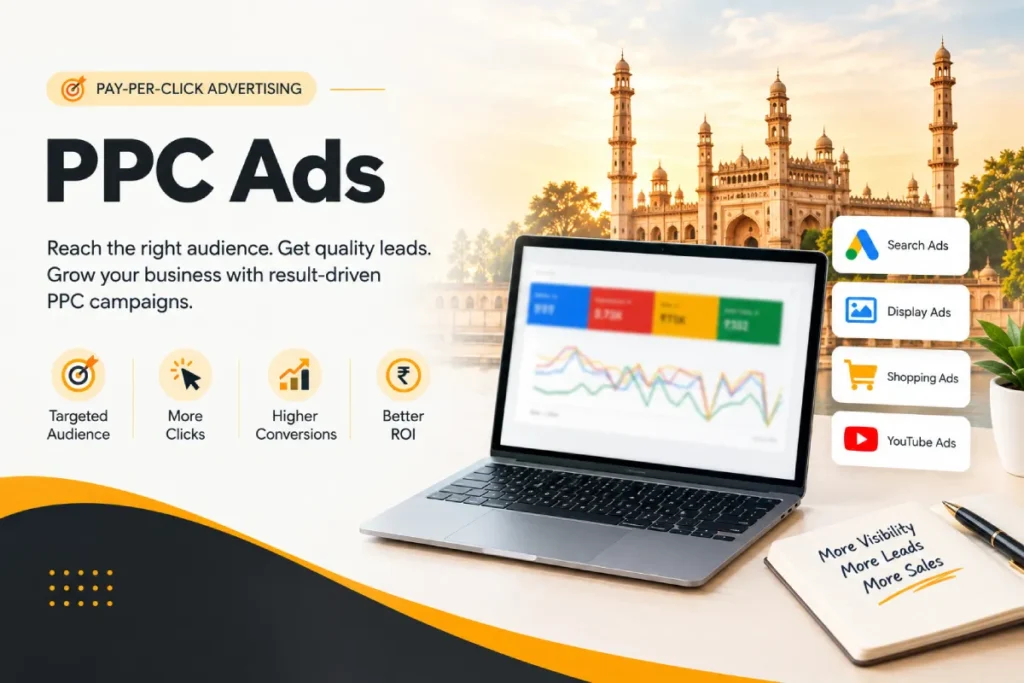
PPC advertising works by showing paid ads to users who are actively searching for relevant products or services. Businesses bid on targeted keywords and pay when someone clicks on their ad. The process involves keyword research, ad creation, right bidding, budget management, and conversion tracking.
Once a campaign is launched, PPC experts monitor metrics such as Clicks, CTR, CPC, conversions, Cost per conversion, and ROAS (for D2C brand) to measure performance. Based on the data, campaigns are continuously optimized by improving keywords, ads, bids, targeting, and budgets to achieve better results.
Search ads appear when users search for products or services related to your business in Google search. They are particularly useful for reaching people with strong purchase or enquiry intent.
Display advertising uses visual ads across relevant websites and digital properties. These campaigns can support brand awareness, audience targeting, and remarketing.
Shopping campaigns showcase products with information such as product images, names, and prices on top of the Google SERP. They are particularly useful for e-commerce businesses looking to drive product-related searches and sales.
Performance Max campaigns allow advertisers to reach potential customers across multiple Google channels through a single campaign structure, using Google’s automated targeting and bidding capabilities.
Remarketing helps businesses reconnect with people who have previously interacted with their website, products, or other digital properties.
Video advertising on YouTube can help businesses build awareness, demonstrate products, educate audiences, and support conversion-focused campaigns.
A PPC Ads Expert is a professional who specializes in planning, launching, managing, and optimizing paid advertising campaigns. Their role goes beyond creating advertisements. They analyze audience behavior, search intent, campaign data, and conversion performance to make informed advertising decisions.
A professional approach can help businesses avoid unnecessary spending and identify opportunities to improve campaign performance.
A digital marketer may work across several areas, including SEO, social media, content marketing, email marketing, and paid advertising.
A PPC expert, on the other hand, focuses specifically on paid advertising performance. Their work involves managing advertising platforms, analyzing campaign data, improving targeting, testing ads, managing bids, and optimizing campaigns toward specific objectives.
Managing paid campaigns effectively requires continuous attention on ads performance, spending budget on right keywords and daily optimisation. Working with an experienced professional can help businesses create a more structured advertising strategy.
PPC can help your business appear when potential customers are actively searching for relevant products or services. By targeting appropriate keywords and audiences, your campaigns can reach users who are already showing interest in what you offer.
Every click does not have the same business value. A well-managed campaign focuses on relevant searches, appropriate bidding, negative keywords, audience targeting, and budget allocation to reduce unnecessary spending.
PPC isn’t simply about increasing website traffic. The objective should be to attract people who are more likely to enquire, purchase, book a service, or take another valuable action.
Campaign targeting, keyword selection, ad messaging, and landing page relevance all influence the quality of incoming leads.
Campaign performance can change over time. Regular optimization helps identify opportunities to improve important metrics such as:
One of the major advantages of PPC is its measurable nature. Businesses can monitor advertising spend, clicks, conversions, leads, sales, and revenue to understand how campaigns are contributing to their objectives.
At PPC Digital, we provide PPC management based on your business objectives, target audience, industry, and available advertising budget.
We help businesses plan and manage different types of Google advertising campaigns, including:
The campaign type is selected according to the business goal rather than using the same approach for every account.
A strong campaign structure creates a foundation for effective management. Our setup process can include:
Choosing the right keywords is an important part of paid search advertising. We analyze search intent and identify terms that are relevant to your products, services, and customers.
Our research can include:
Relevant ad copy can help improve engagement, clickbait and communicate your value proposition clearly.
We develop and test:
Getting a click is only one part of the customer journey. If the landing page does not match the user’s expectations, the campaign may struggle to generate conversions.
We focus on factors such as:
Accurate tracking helps businesses understand which campaigns and keywords are contributing to valuable actions.
Depending on the business, tracking may include:
Once campaigns are live, we analyze performance data to identify areas for improvement.
Optimization can include:
PPC strategies should be based on what a business wants to achieve. A lead-generation campaign, for example, will require a different approach from an e-commerce sales campaign.
PPC can help service-based businesses generate enquiries from potential customers.
It can be useful for industries such as:
The focus is generally on reaching relevant users and encouraging actions such as form submissions, calls, consultations, or enquiries.
For e-commerce D2C businesses, paid campaigns can focus on driving product sales and improving customer acquisition.
Strategies may include:
Local businesses can use PPC to reach customers within specific locations.
Campaigns may focus on:
For a business serving customers in Lucknow, location-based targeting can help concentrate advertising efforts on relevant geographical areas.
Smaller businesses often need to be careful with their advertising budgets. PPC campaigns can be structured around controlled spending, high-intent searches, testing, and measurable acquisition goals.
A structured process helps ensure that campaigns are built around business objectives rather than simply launching advertisements.
We begin by understanding:
This helps establish the foundation for the campaign strategy.
We identify relevant search terms based on:
The objective is to find opportunities that align with what potential customers are actually searching for.
The campaign strategy may define:
We develop ad messaging based on user intent and ensure that the destination page provides a relevant experience.
A strong connection between the search query, advertisement, and landing page can help create a more consistent customer journey.
Before launch, important elements such as targeting, conversion tracking, bidding, keywords, ad variations, and budgets are reviewed.
Once everything is properly configured, the campaigns can go live.
Campaign performance is monitored using relevant metrics such as:
The data helps identify which elements are performing well and where improvements may be required.
PPC management doesn’t end after launching a campaign. We continuously analyze results and make informed adjustments.
This may include:
Looking at the right metrics helps businesses understand whether their advertising investment is producing meaningful results.
CTR measures how frequently users click an advertisement after seeing it. It can provide insights into ad relevance and messaging.
CPC represents the average amount paid for a click. Monitoring CPC helps businesses understand how efficiently their advertising budget is being used.
Conversion rate indicates the percentage of visitors who complete a desired action after clicking an advertisement.
For lead-generation campaigns, CPL helps businesses understand how much advertising spend is required to generate an individual lead.
CPA measures the average cost of acquiring a customer or completing a defined conversion.
ROAS compares revenue generated through advertising with the amount spent on ads. It is particularly important for e-commerce and revenue-focused campaigns.
For relevant Google Search campaigns, Quality Score can provide insight into factors related to keyword, ad, and landing-page relevance.
Choosing a PPC partner should be about more than simply finding someone who can launch campaigns. The right approach should connect advertising activity with your broader business goals.
We use campaign data to guide optimization decisions. Instead of relying only on assumptions, we analyze performance and identify areas where campaigns can be improved.
Every business has different customers, competitors, budgets, and objectives. We develop campaigns around these individual requirements rather than following a one-size-fits-all strategy.
Clicks and impressions are useful indicators, but they don’t necessarily represent business growth. Our approach focuses on valuable actions such as qualified enquiries, purchases, and conversions.
Paid advertising requires ongoing monitoring. We review campaign performance, identify opportunities, test different approaches, and make adjustments based on available data.
Clear reporting helps you understand where your advertising budget is going and what it is achieving.
Reports can include:
Our goal is to connect advertising performance with business outcomes. Whether your objective is lead generation, online sales, customer acquisition, or revenue growth, campaign decisions are made with the broader objective in mind.
Tell us about your business, your current marketing, and where you want to go.
We’ll identify the biggest growth opportunities and recommend the right strategy for your business
Effective PPC isn’t about spending more money. It is about making informed decisions about where, when, and how that budget is used.
We look beyond traffic volume and focus on reaching users whose search behavior indicates genuine interest in the product or service.
A campaign that generates clicks without meaningful actions may not deliver business value. We focus on improving the journey from advertisement to conversion.
Ad messaging, keywords, audiences, and bidding strategies can all influence performance. Continuous testing allows us to identify what works best.
Campaign data provides valuable insights into user behavior and advertising performance. We use those insights to make optimization decisions.
Whether your goal is leads, sales, customer acquisition, or revenue, your PPC strategy should support that objective.
There isn’t one fixed cost for PPC advertising because every campaign has different requirements. Your overall investment depends on factors such as competition, keywords, location, audience, campaign objective, and advertising budget.
Some of the key factors include:
For example, highly competitive commercial keywords may require a different budget and bidding approach than niche or long-tail search terms.
Your ad spend and management fee are separate costs. As your advertising budget grows, so do the responsibilities involved in budget management, optimization, tracking, and performance monitoring. Our management fees scale accordingly to ensure your campaigns receive the attention they need to grow.
Understanding this difference helps businesses plan their overall advertising investment more effectively.
| Daily Ad Spend | Monthly Ad Spend (Approx.) | Management Fee / Month |
|---|---|---|
| ₹1,000–₹2,000/day | ₹30,000–₹60,000 | ₹8,000 |
| ₹2,001–₹3,000/day | ₹60,030–₹90,000 | ₹10,000 |
| ₹3,001–₹4,000/day | ₹90,030–₹1,20,000 | ₹12,000 |
| ₹4,001–₹5,000/day | ₹1,20,030–₹1,50,000 | ₹15,000 |
| ₹5,001–₹7,500/day | ₹1,50,030–₹2,25,000 | ₹18,000 |
| ₹7,501–₹10,000/day | ₹2,25,030–₹3,00,000 | ₹22,000 |
| ₹10,000+/day | ₹3,00,000+ | Custom Pricing |
A successful PPC campaign requires more than putting an advertisement in front of an audience. It requires the right strategy, targeting, messaging, tracking, and continuous optimization.
If you’re looking for a PPC Ads Expert in Lucknow, PPC Digital can help you build a data-driven advertising strategy focused on meaningful business outcomes. Whether your goal is generating qualified leads, increasing online sales, or improving your return on advertising investment, we can create a PPC approach aligned with your business objectives.
Ready to improve your paid advertising strategy? Talk to PPC Digital today and start building PPC campaigns focused on qualified leads, conversions, and sustainable growth.


Trusted by over 50+ clients
We don’t chase vanity metrics—we build businesses. By focusing on strong foundations rather than just dashboards, we craft strategies that drive real, lasting growth. From in-depth audits to seamless execution, we set the stage for success so you can watch your business flourish effortlessly.
A PPC expert can help you develop targeted campaigns, select relevant keywords, manage advertising budgets, optimize ads, track conversions, and improve campaign performance based on data.
There is no universal PPC cost. It depends on factors such as industry competition, keywords, target audience, campaign objectives, and available advertising budget.
PPC can start generating traffic shortly after campaigns are launched, but meaningful performance evaluation generally requires enough data to understand clicks, conversions, costs, and user behavior. The timeline varies by industry, budget, competition, and campaign objective.
The right platform depends on your target audience and business goals. Google Ads can be effective for capturing existing search demand, while platforms such as Meta can be useful for audience-based advertising and discovery.
Yes. Local businesses can use location targeting, relevant keywords, compelling ad messaging, and conversion-focused landing pages to reach potential customers within their service areas.
Yes, we optimize your website for fast loading speed, which improves both user experience and rankings.
Absolutely. We integrate contact forms, CRM systems, analytics, and tracking tools for better performance and data insights.
Typically, it takes 2–4 weeks depending on the complexity and requirements of the project.
Yes, we offer ongoing support, updates, and maintenance to ensure your website runs smoothly.
The cost depends on your requirements, features, and complexity. We offer customized pricing based on your business needs.